Fishing Structure Part I, Tidal Creeks & River Mouths
Fishing Structure Part I, Tidal Creeks & River Mouths
By David Heinke There is an old saying that ninety percent of the fish can be found in ten percent of available water. That might help describe why it seems like you're fishing in the Sahara Desert while your buddy is knocking them dead only twenty feet away! As in real estate, location is everything! The location you want to find is the one with all the fish. To find that location, you need to find the available structure. Structure can take many forms. From the obvious items like; shipwrecks, submerged trees and big rocks, to areas more subtle like oyster bars, channels through flats, and sometimes just a small pile of rocks. All of these locations will hold fish, some more than others, but the size of the structure will help determine how many fish might be in a given area. A depth sounder is an excellent tool to help learn what the bottom looks like in a given area. 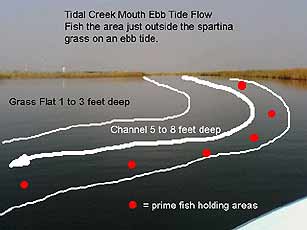 Tidal creeks and river mouths tend to be an excellent source of structure. Many times, the creek channel will wind through areas of alluvial silt, known as deltas or flats. At high or slack tide, game fish will patrol these flats in search of prey. But when the tide starts flowing, game fish will move to the channels and wait for their meal to be brought to them. Tidal creeks and river mouths tend to be an excellent source of structure. Many times, the creek channel will wind through areas of alluvial silt, known as deltas or flats. At high or slack tide, game fish will patrol these flats in search of prey. But when the tide starts flowing, game fish will move to the channels and wait for their meal to be brought to them. Game fish need only a few items to be happy; comfortable water temperature, cover to hide from predators or to ambush prey and of course a supply of food. Think about humans for a moment and lets pretend that we're aliens on a human angling trip. If we observe the humans, after a while we would learn there are three times a day when humans feed, morning, noon, and evening. 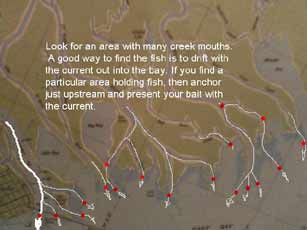 Hungry from their rest, humans will usually try to find something to eat in the mornings. A wise angler would try pancakes or eggs as bait. As the day progresses and the temperatures warm, humans will slow down and not eat as heavily as in the morning or the evening, so a smaller bait like a sandwich or bagel might work best. At dusk, human activity begins anew until the sunsets. To lure the biggest humans during the evening feed, a steak or fried chicken might just land you a lunker. At night, human angling will result in an abundance of the more youthful lively specimens. The large and older humans are harder to catch because they only make brief appearances outside their homes and tend to be more wary about from where their food comes. Hungry from their rest, humans will usually try to find something to eat in the mornings. A wise angler would try pancakes or eggs as bait. As the day progresses and the temperatures warm, humans will slow down and not eat as heavily as in the morning or the evening, so a smaller bait like a sandwich or bagel might work best. At dusk, human activity begins anew until the sunsets. To lure the biggest humans during the evening feed, a steak or fried chicken might just land you a lunker. At night, human angling will result in an abundance of the more youthful lively specimens. The large and older humans are harder to catch because they only make brief appearances outside their homes and tend to be more wary about from where their food comes. Fish do not vary much from the above patterns and given that, the best time to angle for fish would be the times when they are away from their cover and feeding. It takes some observation and experience, but soon you will be able to determine the best place and times to fish. Keep in mind the following observations I have made when fishing tidal creek mouths. Aside from pelagic species, most fish do not move far from home. When a fish is feeding, it also exposes itself to predation. As a result, the fish will tend to be more wary while feeding. Fish will prefer to find a home that provides good cover from predators, a nearby source of food and water deep enough to hold in order to accommodate water temperature changes. If a fish has found a place with good tidal flow, then it doesn't have to waste much energy swimming around looking for food. The tides deliver food to the fish. When fishing in current, remember game fish will swim and face into the current. The food will flow to them so it is best to present your bait with the flow. The better the home, the bigger more aggressive the fish will be. Smaller fish will be either eaten or driven out by the bigger fish. If the area is large enough, many fish will gather for the cafeteria style feeding the tides bring. If there is an obvious item of structure within the creek, such as a tree stump or large rock this will be an excellent area to try for a larger fish. The current will slack and eddy around the structure and a fish holding in the eddy will expand less energy than a fish holding directly in the current. Now that we have a better idea of where and why fish hold in certain areas, lets take a look at how to locate these areas. The first step is to obtain a chart of the area where you want to fish. If a chart is not available, then it might be a good idea to hire a local guide for a day. The knowledge obtained in one day with a guide might take several years to learn on your own. However, if you must go at it alone, then try to find a chart with depths and bottom contours if available. Below is an example of an area where a river flows into a bay along with many tidal creeks. An area that looks like this is a prime area to check out for fish. Also, obtain an accurate tide table for the area. Many are available on the Internet, but you might be able to obtain a tide table in a booklet form that will cover anywhere from a year to several years. Don't just take the tide table for granted, also be aware that atmospheric conditions can alter tides. If a strong wind is blowing against or with a tide, the effects will be increased or reduced depending on whether it is ebbing or flooding. Unfortunately there isn't a book that tells you this, you must learn how the winds affect the tides by experience. In the chart below, we can take a closer look at the same area and focus more upon where to start fishing. The best rule of thumb-and there are always exceptions to the rule-is the best fishing will occur in the creek mouths when the tide is flowing strongest. The middle third of a tide will produce the best flows, while the beginning and end of each tide will have weaker flows until slack-or no flow-tide is reached either at the top or the bottom of the tide. During high tide, it might be a good idea to drift over the flats and cast at fish cruising the flats in search of prey. Also, fish will swim into the creeks and bays in search of food and it would be wise to do the same. At low tide, concentrate on the deepest parts of the river channels or in the pools found amongst the flats. A great way to help find fish feeding on the flats is to look for bird activity. If you see a bunch of birds wheeling and diving into the water-preferably pelicans and terns-you can be sure there are some game fish under the water chasing bait to the surface. A pair of binoculars will help locate feeding birds. When the tide is flowing well, you can start by drifting with the current; casting or jigging your bait as you go. When you locate the fish, head back up current, set the anchor and then let your lure or bait float down current to the feeding fish. Tackle for inshore fishing is dependent upon the type of fishing you choose. I find a light spinning rod and reel equipped with 6 to 10 pound test line to be a good choice. Of course a large tarpon or shark will make short work of such an outfit, but the majority of fish to be found in these areas will give an excellent fight. Bait will always catch fish. Casting lures is more sporting as is fly fishing, but the main thing to remember is to offer the fish what they are currently feeding on. Shrimp, pinfish, finger mullet and crabs are the standard diet of game fish in northern Florida. Find out what lives on the flats and in the creeks and then do your best to imitate that forage with a bait or lure that closely matches the size and color. The old saying, "match the hatch" has implications in all aspects of fishing and doesn't pertain to just trout eating bugs in a mountain stream. One morning striped bass and redfish were just tearing up the water. I was casting a fly that resembled the shrimp they were feeding on, but I couldn't get a single fish to take my fly. I set down the rod and watched the water for awhile. I noticed many shrimp floating by in the current and they were about an inch shorter than the fly I was using. I changed the fly to match the size of the shrimp in the water and began catching one fish after another…literally a fish per cast! Volumes have been written on the subject of fishing creek mouths and I highly suggest reading some of the excellent material available. Hopefully this will help some of you find angling success in your future endeavors. I love fishing creek mouths and if you give it a shot you might too. Next week we will take a look at fishing bays. Until next time,
Don't get caught up a creek without a paddle! This article is printed with permission from West Marine. Visit their website, http://www.westmarine.com for more boating supplies and information.
|